Kitchen Cabinets: Replace or Refinish? The Honest Decision Framework
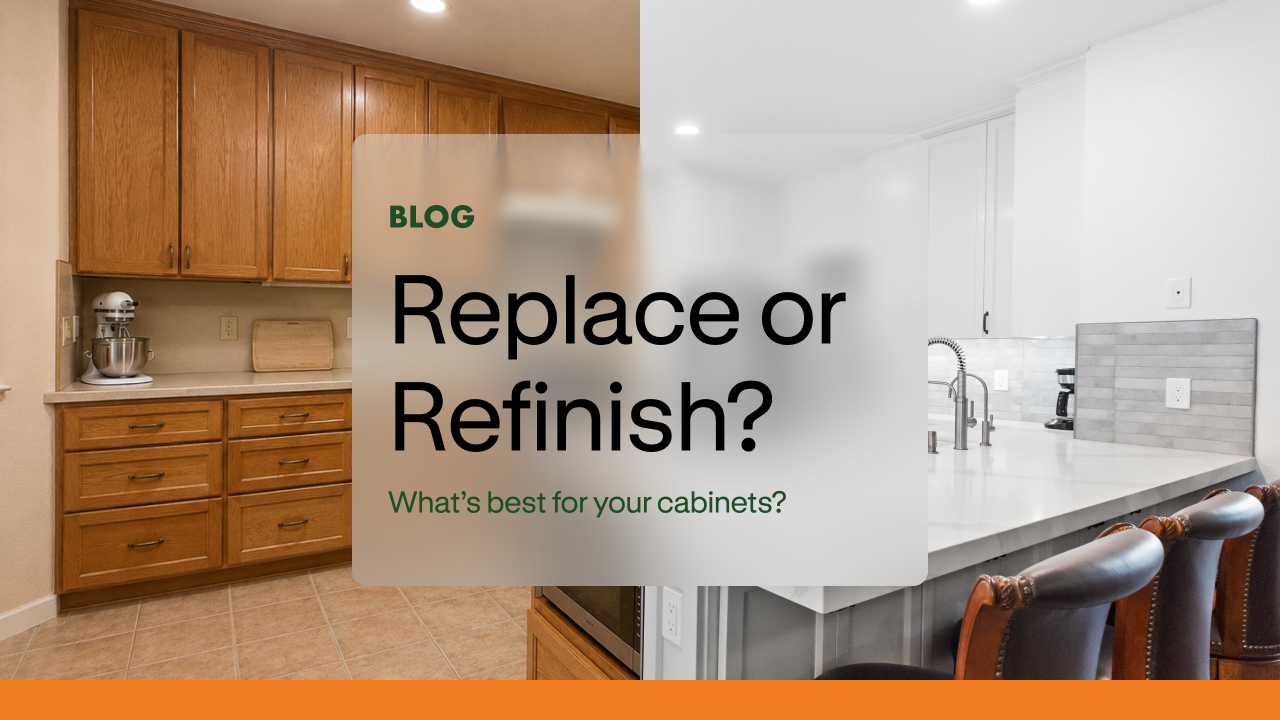
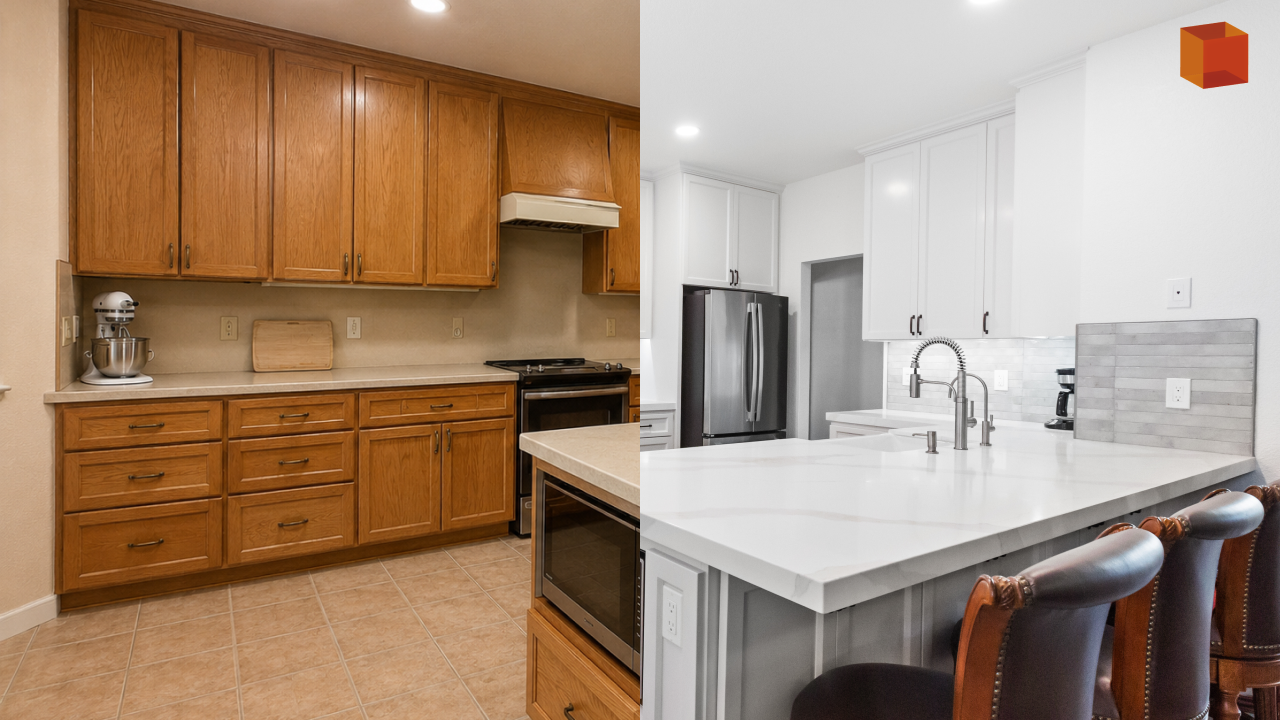
If you've ever stood in your kitchen, coffee in hand, looking at tired cabinets and wondering whether to paint them, swap the doors, or rip the whole thing out, you are asking one of the most expensive questions in home improvement. Get it right, and you save tens of thousands of dollars. Get it wrong, and you either spend money you didn't need to spend, or you spend less than you should have and regret it within a year.
If you've ever stood in your kitchen, coffee in hand, looking at tired cabinets and wondering whether to paint them, swap the doors, or rip the whole thing out, you are asking one of the most expensive questions in home improvement. Get it right, and you save tens of thousands of dollars. Get it wrong, and you either spend money you didn't need to spend, or you spend less than you should have and regret it within a year.
There is good news. After hundreds of kitchen projects across Modesto, Manteca, Elk Grove, Folsom, West Sacramento, and the surrounding Central Valley, we've found that the refinish-versus-replace question almost always answers itself once you know what to look at. It is not a gut call. It is not a question of taste alone. There is a simple framework, and we're going to walk you through it the same way we walk our customers through it on a phone consultation.
The short version: a handful of specific conditions trigger a full cabinet replacement. If none of those conditions are present, refinishing is a legitimate option that can save you roughly 40% on a full kitchen remodel. Below, we'll break down each of those triggers, explain the third option most homeowners don't know exists (refacing), and answer the questions homeowners are typing into Google when they start this journey.
The core principle: replacement is triggered, not chosen
Here's the mental model we use at kitchen & bath CRATE. Start by assuming your cabinets can be refinished. Then walk through five conditions. If any one of them is true, refinishing is off the table and you need new cabinets. If none of them is true, refinishing is back in play and probably the smarter move.
Those five conditions are:
- The existing cabinets are no longer structurally sound.
- The cabinet material itself can't be refinished.
- The layout no longer works for your life, your appliances, or your renovation plans.
- Modern appliance sizes don't fit your current openings.
- You hate the look of the cabinet construction itself, not just the color.
Let's take each one in turn, because the details matter, and these are the questions every honest contractor should be helping you think through before they quote you a price.
Trigger 1: Structural integrity
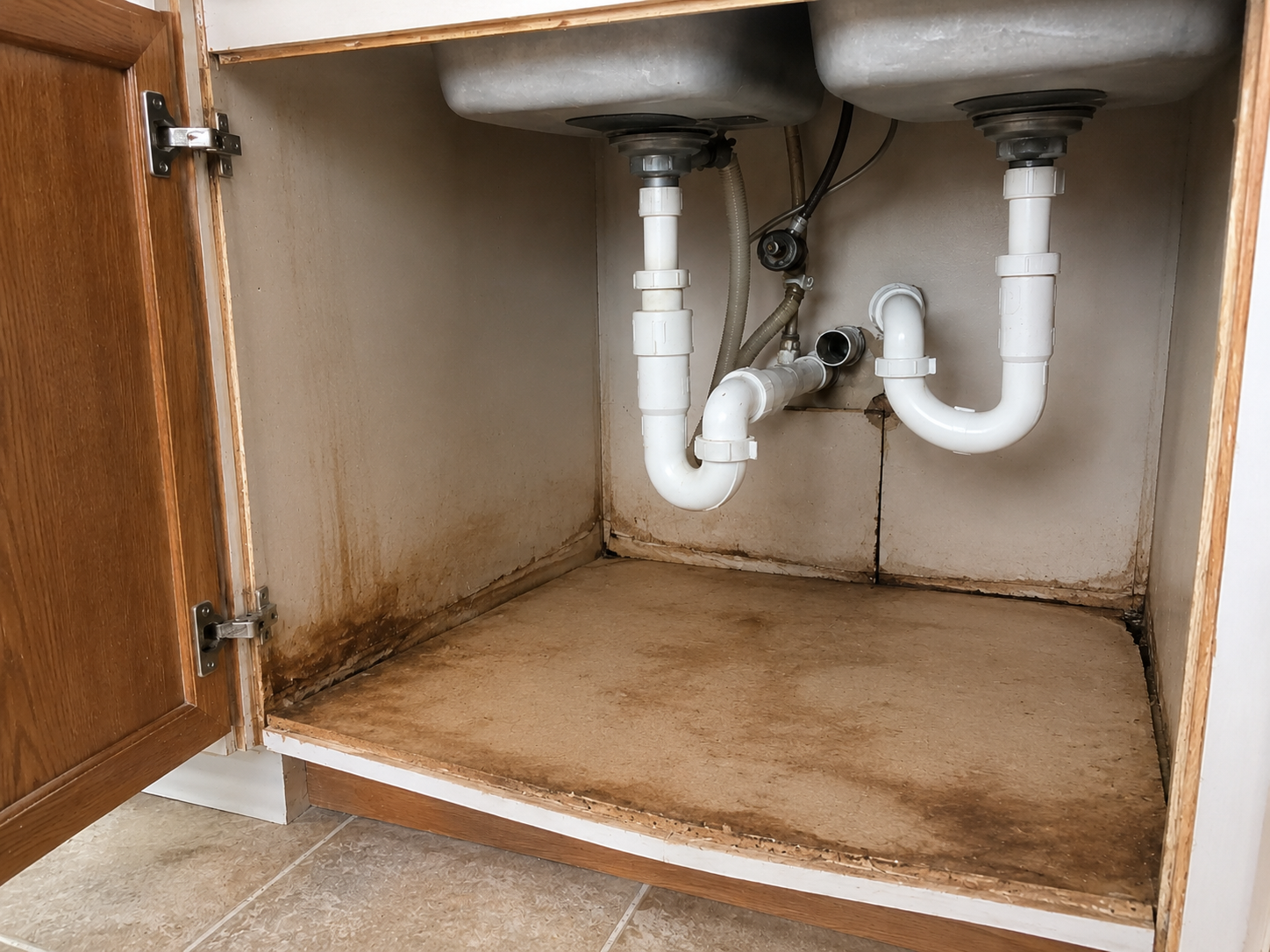
The first thing we look at is whether the cabinet boxes themselves can be saved. A cabinet box is essentially a five-sided plywood or particleboard structure that holds your dishes, supports your countertop, and anchors the doors and drawers. If that box is failing, paint won't fix it. Beautiful new doors won't fix it. You're putting a fresh coat of lipstick on a structure that's going to keep failing.
We see structural failure for a few common reasons. Cheaply manufactured cabinets, often imported, sometimes start sagging, separating at the joints, or losing their backs within ten or fifteen years. Cabinets damaged by water, usually under the sink or around the dishwasher, can rot from the inside out. Heavy use, abuse, or impact damage, sometimes from pets or kids, can compromise structural integrity over time.
One thing worth saying clearly: age alone is not the problem. Some of the best-built cabinets we see are old. Mid-century and earlier construction often used solid hardwoods and joinery that simply doesn't exist in modern factory work. We've refinished plenty of cabinets that were older than the homeowner and that will likely outlast the new countertops going on top of them. The question is condition, not vintage.
A reputable contractor should physically inspect your cabinet boxes — opening doors, pulling drawers, looking inside corners, checking for water damage, testing whether shelves are still anchored — before quoting either option. If someone tries to price your project from a phone call alone, that's a flag.
Trigger 2: The cabinet material can't be refinished
This is the one that surprises homeowners most. Some cabinets simply cannot be painted, no matter how skilled the painter is. The two materials that come up most often are Thermofoil and plastic laminate.
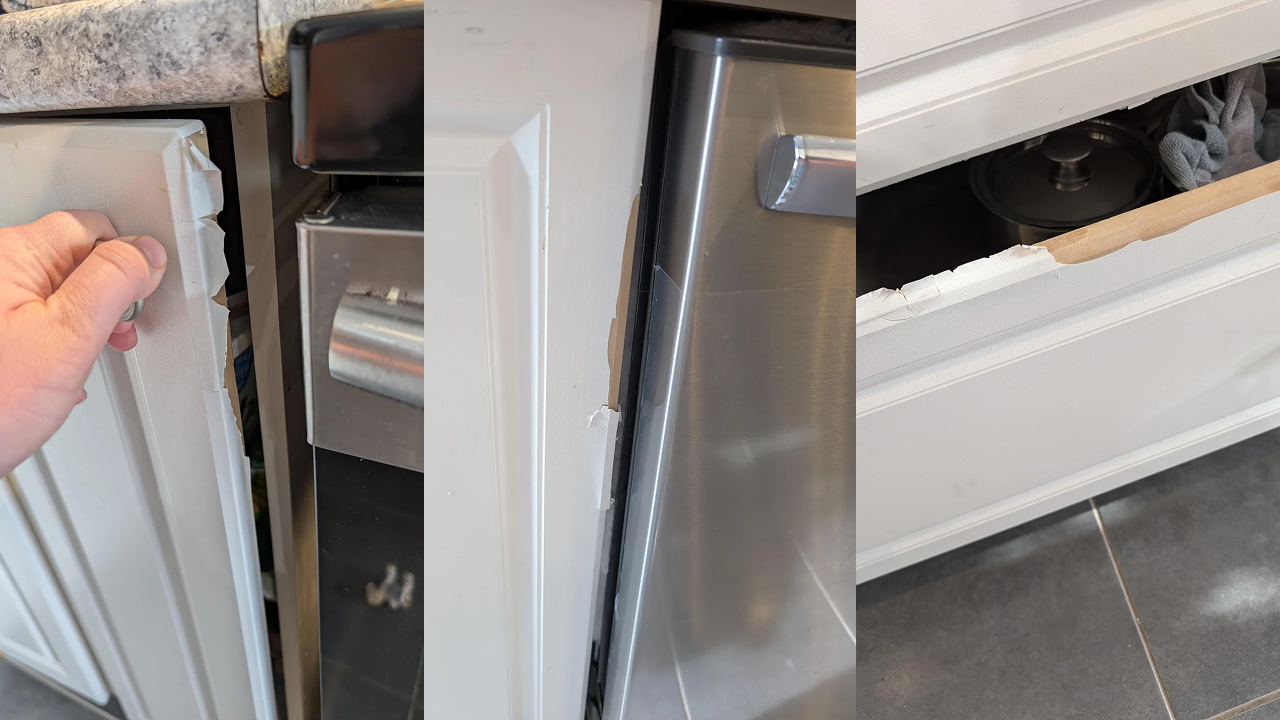
Thermofoil was extremely popular in the late 1990s and early 2000s. It's essentially a sheet of vinyl that's heat-pressed onto a substrate, typically MDF for the doors and drawer faces, with melamine for the boxes. From a distance, Thermofoil cabinets can look like painted wood. Up close, they have a slightly plasticky, often glossy appearance, and over time, the vinyl tends to peel away at the corners, especially near heat sources like ovens and dishwashers.
The trouble with Thermofoil is that nothing sticks to it well, including paint. The same goes for the melamine boxes, which are essentially paper-laminated particleboard with a non-porous surface. To make these cabinets paintable, you'd have to strip the vinyl entirely, sand or chemically treat the substrate, and apply specialty bonding primers — and even then, the results are unpredictable. By the time you've done all that work, you've spent two to four times what new cabinets would have cost. It's not a close call. If you have Thermofoil cabinets, you're replacing them.
Plastic laminate, which is the same family of material as Formica countertops applied to cabinet faces, presents the same problem. It's a non-porous, non-absorbent surface engineered specifically to resist coatings. You can technically paint over it with specialty primers, but the durability is poor, and it's almost never worth the cost or the risk.
Beyond those two specific materials, there's a separate question about whether the existing finish is salvageable. Real wood cabinets with damaged exteriors — heavy splintering, significant sun-faded discoloration, water-warped panels, or deep gouging — may be structurally fine but cosmetically too far gone. The labor required to sand, fill, and re-prep those surfaces to a paintable state can exceed the cost of new doors. We make that call on a case-by-case basis, but the general rule is: minor surface damage is fine, widespread surface failure usually isn't.
Trigger 3: The layout no longer works
Even if your cabinets are gorgeous, well-built, and refinishable, none of that matters if the layout itself is the problem. Cabinets are not movable furniture. They are built into the walls, anchored to the studs, and connected to the plumbing, electrical, and flooring around them. Once you start moving them, you might as well start fresh.
Layout-driven replacement comes up in a few common scenarios. Sometimes it's structural — you're taking down a wall to open the kitchen to the living room, and the cabinets that lived on that wall have nowhere to go. Sometimes it's functional — the original 1980s work triangle puts the refrigerator across the room from the sink, and you've been frustrated cooking in that kitchen for a decade. Sometimes it's accessibility — a homeowner with a new mobility need can't reach upper cabinets safely or maneuver a wheelchair through the existing footprint. And sometimes it's pure aesthetics — you simply hate the layout and want a kitchen island, a larger pantry, or a different cooking workflow.
These are all valid reasons to replace, but they're worth being honest with yourself about. If your only complaint about the layout is that the cabinets look dated, layout isn't really the issue — the finish is, and that's solvable. But if you'd want a different floor plan even if the cabinets were brand new, then refinishing is just delaying a bigger project.
Trigger 4: Modern appliances don't fit
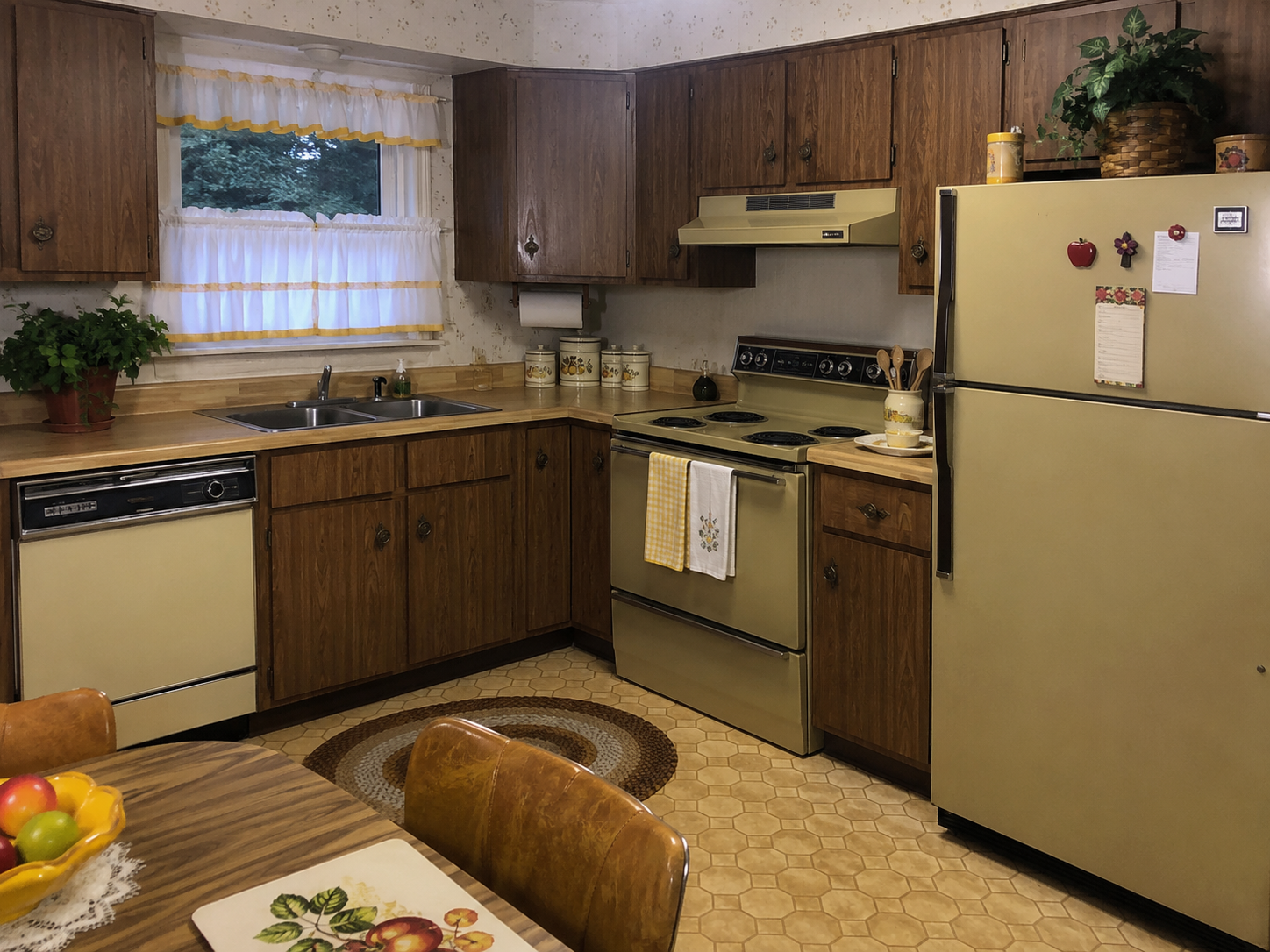
This is the trigger that homeowners often overlook until they're standing in an appliance showroom. Kitchen appliances have grown over the last several decades. The 30-inch range your grandmother had has been replaced by 36-inch and 48-inch professional ranges. Refrigerator widths have crept upward, and counter-depth and built-in models often need precise opening dimensions. Microwave drawers and convection wall ovens come in sizes that simply didn't exist when many homes were built.
If you're refinishing, your appliance openings stay exactly as they are. That's fine if you're keeping your existing appliances or buying replacements in the same dimensions. It's a problem if the appliances you want require larger or differently shaped cabinet openings. Modifying cabinet openings is sometimes possible, but extensive modifications cross the line where replacement makes more sense.
Dishwashers are the one consistent exception — they've been a standard 24 inches wide for decades, so they almost never trigger this issue. But ranges, ovens, microwaves, and refrigerators all can and do. Before you commit to refinishing, sketch out the appliance footprint you want and confirm it fits the openings you have.
Trigger 5: You hate the cabinet construction, not just the color
This last one is more subjective, but it's real. Some homeowners look at their natural oak or maple cabinets and want a clean, modern painted look. That's totally achievable through refinishing — except in one common case. If you're painting over heavily grained wood like oak, that grain will telegraph through the paint unless extensive prep work is done to fill the grain. Some people love that look, called heavy-grain transference. Others hate it and want a perfectly smooth, modern finish that real oak just won't deliver under paint.
If you fall in the second camp, refinishing your existing oak cabinets will leave you disappointed. The solution is either replacing the doors and drawer faces (refacing, which we'll get to in a moment) or replacing the cabinets altogether with smooth-faced material.
Other construction-related issues that may push you toward replacement include outdated door styles that can't be modified, raised panel profiles that are physically incompatible with the modern flat-panel look you want, or cabinet box configurations (no soft-close drawers, no roll-out shelves, no full-extension hardware) that can't be retrofitted economically.
The third option most homeowners miss: refacing
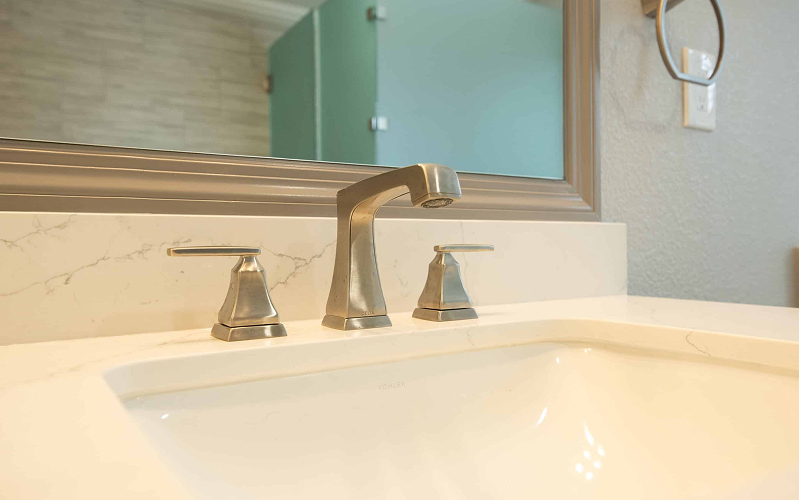
So far we've talked about refinishing versus replacing as if they were the only two options. They're not. There's a middle path that solves a surprising number of these problems: refacing.
Refacing keeps your existing cabinet boxes — assuming they're structurally sound — but replaces the doors and drawer faces with brand-new ones in the style, material, and color you want. You also typically replace the exposed end panels and apply a new veneer or paint to anything visible. From the outside, a refaced kitchen looks like a brand-new kitchen. From the inside, it's your existing storage.
Refacing is the right answer when your boxes are great but your finish material isn't paintable (think Thermofoil — you can keep the melamine boxes and just put new doors on them), or when you want a smooth, modern door style without grain transference but don't want to replace the boxes, or when you want to upgrade to soft-close hinges and modern hardware without a full demo.
Refacing usually lands between refinishing and full replacement on price. It costs more than paint because you're buying new doors and drawer faces, but it costs less than replacement because you're keeping the most labor-intensive part of the cabinetry — the boxes themselves — exactly where they are.
The real cost difference
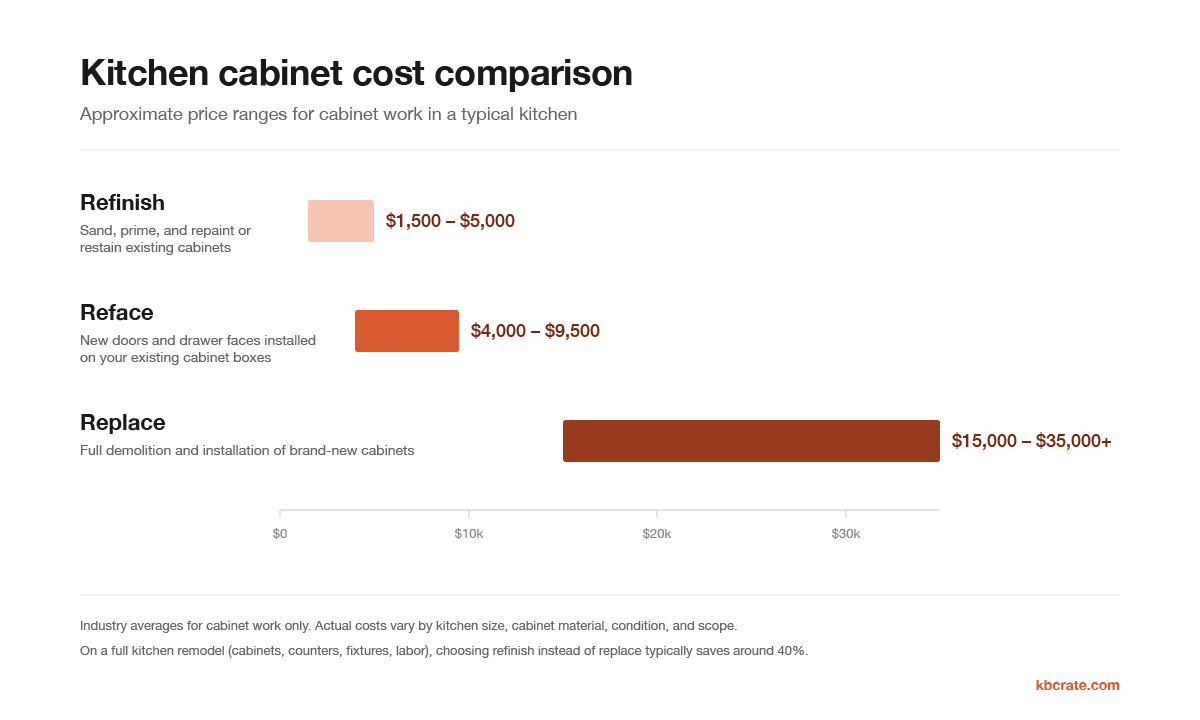
Here's where the rubber meets the road. If your cabinets pass the five triggers above and refinishing is a legitimate option, the savings are substantial. On a typical $80,000 kitchen project, refinishing instead of replacing the cabinets generally saves around 40% of the total cost. That's roughly $32,000 staying in your pocket.
It's worth being clear about why that number is so big. Cabinets are typically the single largest line item in a kitchen remodel — often 30% to 40% of the entire project budget on their own. New cabinets aren't just expensive in materials; they require demolition, disposal, careful templating of the new boxes, coordination with countertop and appliance installation, and significant labor to install correctly. When you refinish, you eliminate almost all of that, keeping only the prep, paint, and reinstallation labor. The countertop you might otherwise have to replace can often stay. The plumbing and electrical rough-ins don't move. The flooring under and around the cabinets stays intact.
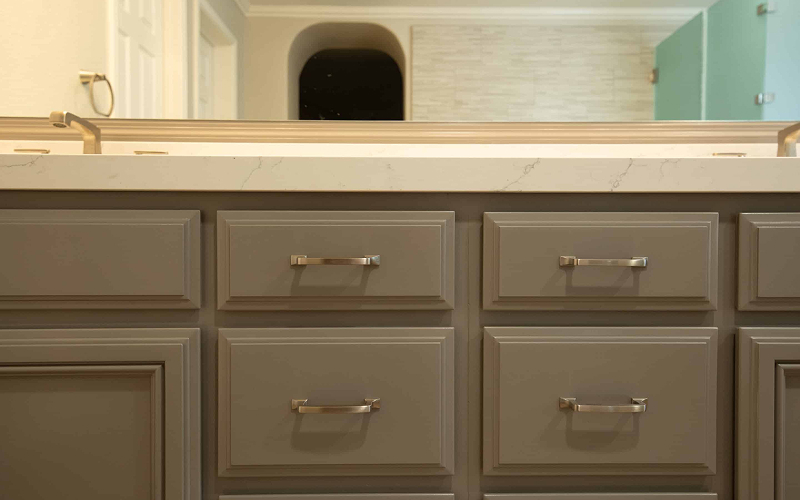
That said, a refinished kitchen is not a "cheap" kitchen. Done correctly, with proper prep, professional-grade primers, two coats of finish paint applied in a controlled environment, and quality hardware, a refinished cabinet should look new for many years. We back our refinish projects with a two-year guarantee for exactly that reason. The corners to be careful about are contractors who skip the prep, spray over greasy or unsanded surfaces, or use bargain paint that yellows and chips. Cheap refinishing is worse than no refinishing.
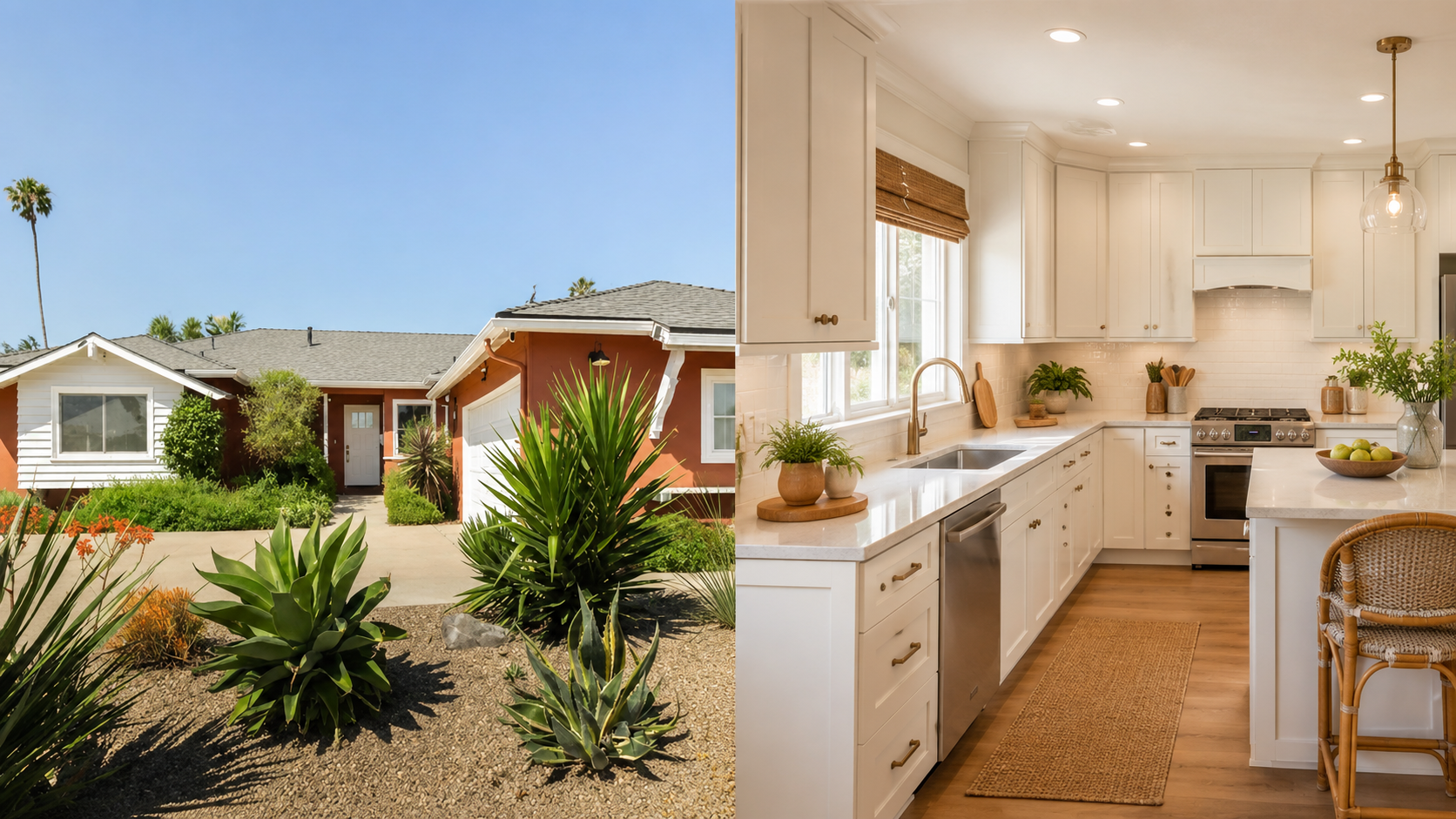
Why so many California Central Valley homes are perfect refinish candidates
Homes built between roughly 1970 and 2015 are often ideal candidates for refinishing. The reason is simple: by the late 1960s and early 1970s, residential cabinet construction in California had settled into a pretty good standard. Solid wood or quality plywood boxes, hardwood face frames, real wood doors and drawer faces. Mass-produced, but well-built. The layouts of homes from this era are usually functional — kitchen triangles work, rooms are appropriately sized, and counter space is adequate. The dating of these kitchens is usually about color and style, not bones.
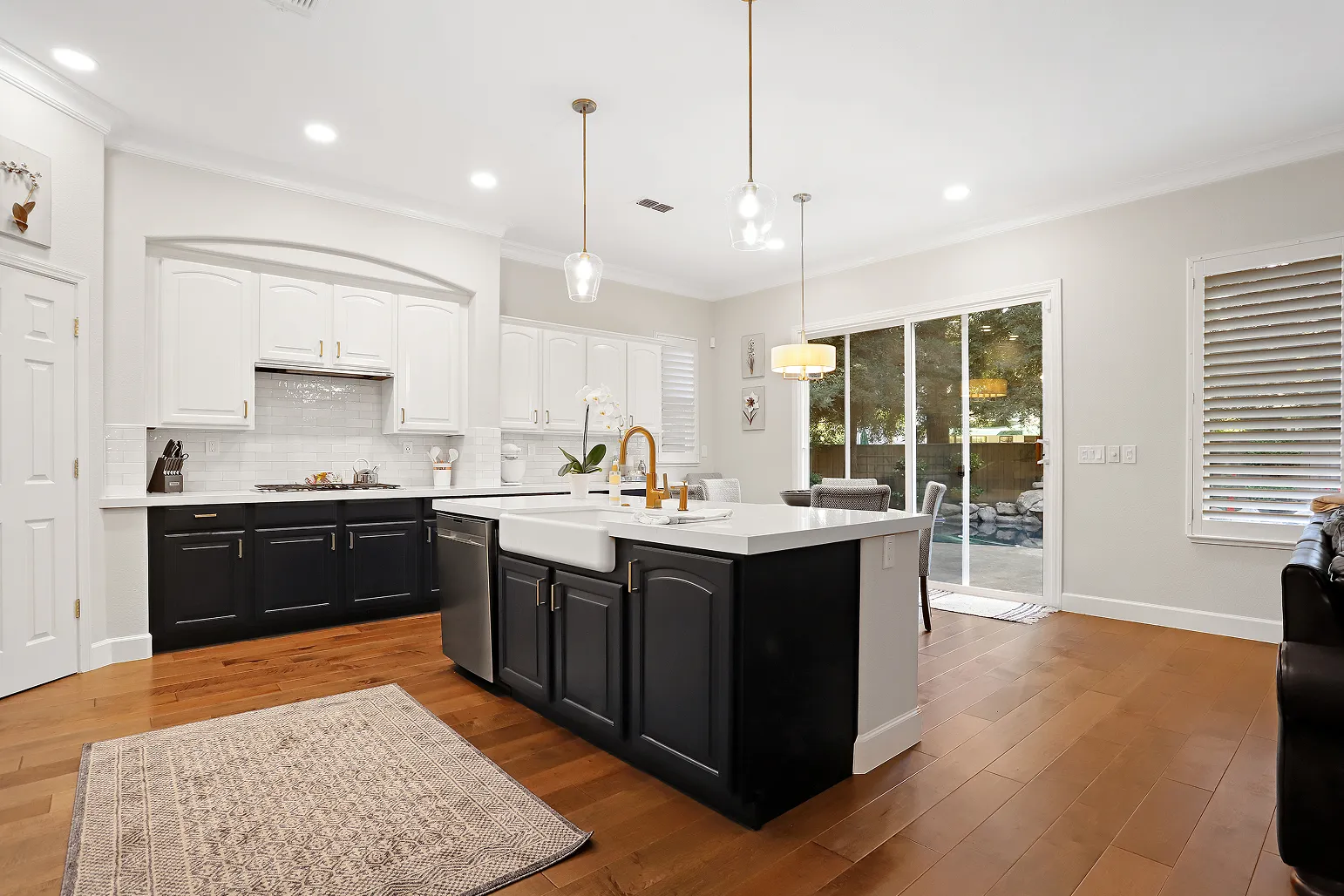
If you're in a 1980s or 1990s Modesto ranch, a 2000s Elk Grove tract home, or a 1970s West Sacramento bungalow, there's a strong chance your cabinets are structurally great, your layout works, your appliances fit, and you simply hate the honey-oak or whitewash look that's defined your kitchen for two decades. That's our exact sweet spot. A refinish in a modern color — soft white, deep navy, warm gray, classic black — combined with new hardware, refinished or replaced countertops, and a fresh backsplash can transform that kitchen so completely that it doesn't even read as the same room.
Common questions homeowners ask before deciding
How long does cabinet refinishing take compared to replacement? A professional refinishing project typically takes about a week to ten days from setup to completion, with the doors and drawer faces sprayed in a controlled offsite paint booth for the best finish. A full cabinet replacement, by contrast, usually runs five to nine weeks depending on cabinet lead times, demolition, and coordination with countertops. The disruption difference is enormous — most homeowners can keep using parts of their kitchen during a refinish; almost none can during a full replacement.
Will refinished cabinets actually last? Yes, when they're done correctly. The key variables are surface prep, primer quality, paint quality, and application environment. Cabinets that are properly cleaned, deglossed, sanded, primed with a bonding lacquer primer, caulked at all joints, and finished with two coats of a high-quality cabinet-grade paint applied in a paint booth will hold up to daily kitchen use for many years. We've gone back to refinish projects from a decade ago that still look great. The failure mode for refinishing is almost always shortcut prep, not the concept itself.
Does refinishing add value to my home? A refreshed kitchen is one of the highest-ROI improvements you can make to a home, and refinishing captures most of that ROI at a fraction of the cost of a full remodel. Buyers walking through a home aren't grading your cabinet boxes — they're reacting to whether the kitchen looks current, clean, and well-maintained. A professional refinish delivers exactly that impression. For homeowners not planning to move, the daily-enjoyment value is even higher relative to cost.
Can I just refinish my cabinets myself? You can, but we’ve been called in to repair DIY cabinet refinishing more often than we’ve seen it successfully executed.. There are real reasons most DIY cabinet paint jobs look like DIY cabinet paint jobs. Achieving a factory-quality finish requires the right equipment (a spray gun and ideally a small booth), the right products (bonding primers and cabinet-grade enamels are not the same as wall paint), real expertise in surface prep, and the patience to do every step properly. The most common DIY failure modes are brush marks, drips, peeling paint within a year, and finish color that doesn't match between doors, drawers, and boxes. If you want professional results, hire a professional.
Is Thermofoil really that bad? Thermofoil itself was a reasonable material when it was new — affordable, smooth, and easy to clean. The problem is that it ages poorly. The vinyl delaminates, especially near heat. It can't be repainted. It can't be repaired. And it's almost always paired with melamine boxes, which have the same limitations. If you have Thermofoil cabinets you want to keep, your only real option is refacing — keeping the boxes and replacing the doors with paintable material — or full replacement.
Should I refinish if I'm planning to sell within a year? This depends on your kitchen's specific issues. If the cabinets just look dated, refinishing can dramatically improve listing photos and buyer reaction at a small cost relative to the price bump. If the kitchen has functional problems a buyer will notice — bad layout, undersized appliances, poor lighting — refinishing won't solve those, and the money is better spent on staging or a price adjustment. A good remodeling consultation should be candid with you about which category you're in.
A simple decision flow for homeowners shopping a contractor
When you're sitting down to talk with a remodeling contractor — whether that's us or anyone else — the conversation should go in a specific order. First, an honest assessment of cabinet condition: structure, material, finish, hardware. Then a conversation about your layout and how well it serves your life. Then a check on appliances, current and future. Then a discussion of design taste — are there fundamental construction or style issues you can't get past with a color change? And only then a real conversation about cost.
If a contractor leads with price before they've assessed any of those five triggers, they're either guessing or selling. The right contractor will walk you through the decision the way we just did above and let the answer fall out of the facts, not push you toward whichever option is more profitable for them. The right answer for your kitchen is the right answer regardless of which option it points to.
Where kitchen & bath CRATE fits in
We built kitchen & bath CRATE around exactly this question. Our kitchenCRATE Refinish product is built for homes where the bones are good and you want a transformation without the budget and disruption of a full remodel. Our kitchenCRATE Custom product is built for homes where the five triggers above call for new cabinets, a new layout, or both. And we offer the in-between options too — refacing, countertop-and-backsplash-only updates, and full remodels — because we'd rather help you pick the right option than push you toward whichever one we'd prefer to sell.
If you're somewhere in this decision and want a real consultation — not a sales pitch — we'd be happy to walk through your kitchen with you, whether that's in Modesto, Manteca, Elk Grove, Folsom, West Sacramento, Stockton, or anywhere else in the Central Valley and greater Sacramento area we serve. Most homeowners come away from a consultation with a much clearer sense of which path is right for their home, even if they ultimately work with someone else.
You can schedule a phone consultation through kbcrate.com or give us a call at 888-995-7996. Bring questions. Bring photos. Bring your worst kitchen frustrations. We've probably seen them before, and we can almost certainly tell you in about thirty minutes whether refinishing, refacing, or replacing is the smart move for the kitchen you've actually got.
The cabinets question doesn't have to be confusing. Walk the five triggers, be honest about what you find, and the right answer will tell you what it is.






We are very impressed by the professionalism that Bath Crate had as they took care of us and our project. They were punctual, informative, and friendly at every point of the remodel.
Ron & Wendy R.